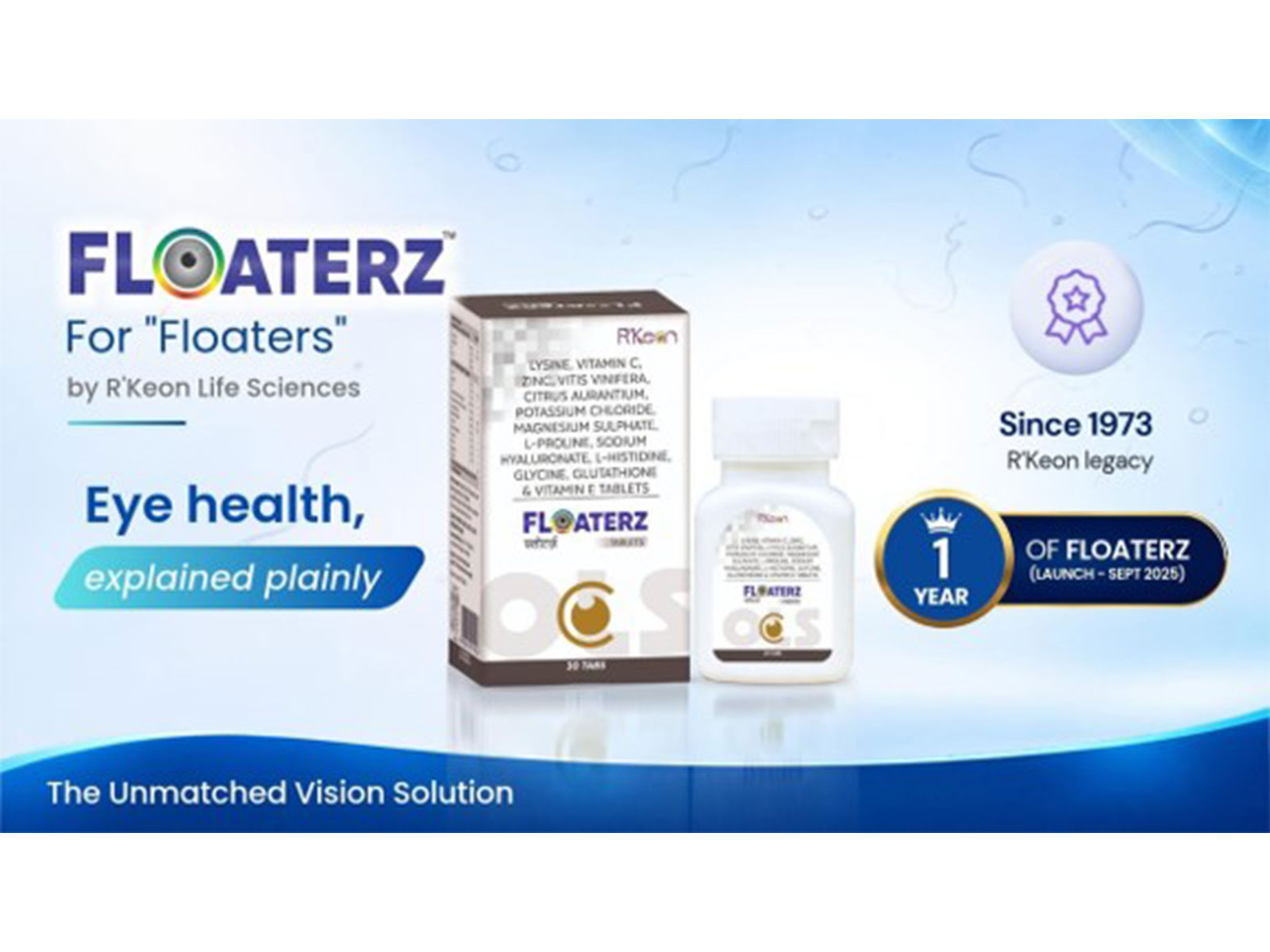
R’Keon Life Sciences marks one year of FLOATERZ, urges eye check for sudden floaters
Nov 14, 2026
VMPL
New Delhi [India], November 14: R’Keon Life Sciences has marked one year of FLOATERZ, its eye health supplement launched in September 2025, and urged people who notice a sudden increase in floaters to get an eye check promptly. Floaters are the small spots, specks or thread-like shapes that drift across the vision, and the clinical term is myodesopsia. Most are a minor nuisance, but a sudden increase can be caused by a retinal tear, Mayo Clinic notes, which is why the company is stressing an early visit to an eye-care professional.
Floaters are among the most common visual complaints, and among the least discussed. A 2016 review in the Journal - Eye (The Scientific Journal of The Royal College of Ophthalmology) reported that, in a community survey of 603 smartphone users, most of them under 50[1] , 76% said they saw floaters and 33% said they affected their vision. The authors cautioned that people who worry about their eyes may be more likely to answer such surveys, so the figures need careful reading.
For most people eye floaters remain a minor irritation. For some they raise real questions, and for a few they are the first sign of something that needs urgent attention. R’Keon Life Sciences, an ophthalmic speciality pharmaceutical company, says it wants to be part of that conversation in a measured way.
What floaters are, and why they appear
Floaters look like small specks, dots, circles, lines or cobwebs in your field of vision. Floaters are tiny clumps of gel or cells inside the vitreous that fills your eye. What you see are the shadows these clumps cast on your retina.
The vitreous, the clear gel that fills much of the eyeball, is more than 98% water, held in shape by a fine network of collagen fibres and hyaluronan, according to the same review. With rising age the gel gradually liquefies and the collagen fibres can clump together. Those clumps cast faint shadows on the retina, and the brain registers them as spots, threads, cobwebs or rings drifting through the vision, most visibly against a clear sky, a white wall or a blank screen. The US National Eye Institute describes the same process as the vitreous slowly shrinking, with the shadows appearing as floaters.
Eventually the gel can pull away from the back wall of the eye, an event known as posterior vitreous detachment (PVD). It often brings a sudden increase in floaters and, in most cases, is not sight-threatening and needs no treatment, according to National Eye Institute material. The American Academy of Ophthalmology has also noted that floaters tend to fade or become less bothersome over time.
Who is more likely to notice them
Floaters become more common with age, and among people who are nearsighted (myopia), have had cataract surgery or have had inflammation inside the eye, according to guidance attributed to the American Academy of Ophthalmology. In the smartphone survey, nearsighted respondents were 3.5 times more likely to report symptomatic floaters, and the Eye review notes that these ageing changes in the vitreous are accelerated in myopia.
Why this matters in India
That link makes the country’s myopia trend relevant. A 2021 study estimated that myopia among urban Indian children aged 5 to 15 rose from 4.44% in 1999 to 21.15% in 2019, and it projected further increases as these generations age. A meta-analysis of four decades of Indian school studies put the pooled figure at 8.5% for urban children and 6.1% for rural children, and a review in Community Eye Health attributes the higher urban figures largely to near work and screen use. These are myopia figures, not floater figures, and the sources reviewed for this article contained no Indian data on floaters. Because vitreous changes appear earlier in nearsighted eyes, the rise in myopia is one reason the subject is relevant to younger readers as well.
When floaters are a warning sign
The same shadows that are harmless in one person can signal a problem in another. The National Eye Institute says anyone who notices a sudden increase in floaters, flashes of light in peripheral vision, or a loss of peripheral vision should have an eye-care professional examine their eyes as soon as possible. Mayo Clinic lists a retinal tear, with or without retinal detachment, among the causes of a sudden increase in floaters, and notes that an untreated tear may lead to detachment. Other causes include infection, inflammation of the eye (uveitis), bleeding in the eye (hemorrhage), which can follow conditions such as diabetes or high blood pressure, and eye injury.
In a Netherlands study reported by UF Health [2] (University of Florida Health), about one in five patients who suddenly saw a burst of floaters were later diagnosed with a retinal tear or detachment. Doctors check for such problems through a dilated eye examination, the National Eye Institute notes.[3]
How floaters are managed today
Treatment depends on the cause. If floaters are caused by ageing and do not bother the person, the National Eye Institute says treatment is usually unnecessary. When they interfere with daily life, an eye doctor may suggest a surgery called vitrectomy, although NEI[4] ( National Eye Institute) material adds that most eye surgeons are reluctant to operate unless vision is seriously affected.
The evidence base is modest. The Eye review found the quality of evidence on managing floaters limited, with most studies retrospective. Satisfaction after vitrectomy was generally high across the studies it examined, but cataract developed in roughly a quarter to well over half of patients who still had their natural lens, and the rate of retinal detachment ranged from none to 10.9% depending on the series. Laser treatment, it concluded, rests on a thin evidence base with results that vary considerably between studies. The review’s closing point is that patients should decide with full information about the risks.
The everyday impact
Vision charts often look normal in people troubled by floaters, which is partly why the burden is easy to underestimate. A 2025 qualitative study of 44 patients, published in the Journal of Patient-Reported Outcomes, grouped their experiences into 11 areas, including activity limitations, emotional well-being, social well-being and the need for coping strategies. For most people symptoms settle as the brain adapts and the floaters drift out of the line of sight. A minority continue to be troubled for months.
FLOATERZ: what the company says
According to R’Keon Life Sciences, FLOATERZ is an eye health supplement of curated micronutrients, available in a pack of 30 tablets.
As per the R'Keon ’s product information, each tablet contains lysine (125 mg), vitamin C (50 mg), Vitis vinifera extract (proanthocyanidins, 26.3 mg), zinc (10 mg), Citrus aurantium (100 mg), L-proline (150 mg), glutathione (50 mg), sodium hyaluronate (50 mg), L-histidine (20 mg), glycine (20 mg), potassium chloride (200 mg), magnesium sulphate (150 mg) and vitamin E (10 mg). notes that R'Keon’s composition is given with reference to RDA as per ICMR guidelines, and that the tablet is gluten-free, lactose-free and vegan.
The product information advises one tablet daily, taken with some liquid after a meal, for at least three to six months, without exceeding the recommended daily intake. FLOATERZ should be taken as directed on the pack and leaflet, or as advised by a doctor. The company also states that it is not a substitute for a varied, balanced diet or a healthy lifestyle.
A note on responsible use
Floaters should not be self-diagnosed, and a supplement is not a substitute for an eye examination. Anyone who notices new, sudden or worsening visual disturbances, such as a shower of floaters, flashes of light, or a shadow or curtain across part of the vision, should see an eye-care professional promptly. Anyone considering a supplement should also discuss it with their doctor.
“Conversations about eye health often begin with something small that a person notices and isn’t sure how to describe. Our aim is to explain what we offer in simple language, be clear about what a product is meant for, and be equally clear that anything new or sudden in your vision deserves a prompt visit to an eye-care professional.”
— RIDIM AGARWAL, CEO, R’KEON LIFE SCIENCES
About R’Keon Life Sciences
R’Keon Life Sciences is a national ophthalmic speciality pharmaceutical company, in the field since 1973.
Ridim Agarwal, CEO, is a third-generation pharma entrepreneur with more than 15 years in healthcare, focused on the ophthalmic value chain.
Where to find more
FLOATERZ is available through R’Keon’s online store, on 1mg and at doctor-attached pharmacies across India. Further information, including the product leaflet, is available at rkeon.com.
MEDIA CONTACT
R’Keon Life Sciences | Media enquiries
Email: [email protected]
(ADVERTORIAL DISCLAIMER: The above press release has been provided by VMPL. ANI will not be responsible in any way for the content of the same.)