India's Quiet Vascular Crisis: Thousands Die Each Year From an Aneurysm They Never Knew They Had
May 20, 2026
VMPL
Hyderabad (Telangana) [India], May 20: Vascular Health: An aortic aneurysm grows in silence, shows no symptoms, and kills within minutes when it ruptures. A Hyderabad vascular surgeon is calling for greater public awareness of a condition that remains dangerously under-screened across India.
"When a patient in their fifties comes in with a ruptured aortic aneurysm, you are not treating a medical emergency - you are managing a catastrophe," says Dr. Bhavin L. Ram, Consultant Vascular and Endovascular Surgeon at Yashoda Hospitals, Hitec City, Hyderabad. "The tragedy is that in most of these cases, a simple ultrasound scan done earlier would have given us time to act."
Globally, aortic aneurysms are responsible for an estimated 150,000 to 200,000 deaths every year [1] - a toll experts say is disproportionately high given that the condition is both detectable and treatable. In India, the problem is compounded by low awareness, minimal screening culture, and a tendency to dismiss vague abdominal or back pain until it is too late.
What the Body Keeps Hidden
The aorta is the body's largest artery, running from the heart through the chest and abdomen. An aortic aneurysm occurs when a section of the arterial wall weakens and balloons outward - producing no pain, no symptoms, and no warning. [2] The two most common forms are the Abdominal Aortic Aneurysm (AAA) and the Thoracic Aortic Aneurysm (TAA). When either rupture, it causes catastrophic internal bleeding. Research shows ruptured AAA carries an overall mortality rate of 65 to 85 per cent, including patients who never reach hospital. [3]
"The dangerous thing about an aortic aneurysm is its silence. Patients feel nothing until rupture - and when it does, the window to save a life is measured in minutes, not hours." - Dr. Bhavin L. Ram
Who Is Most at Risk
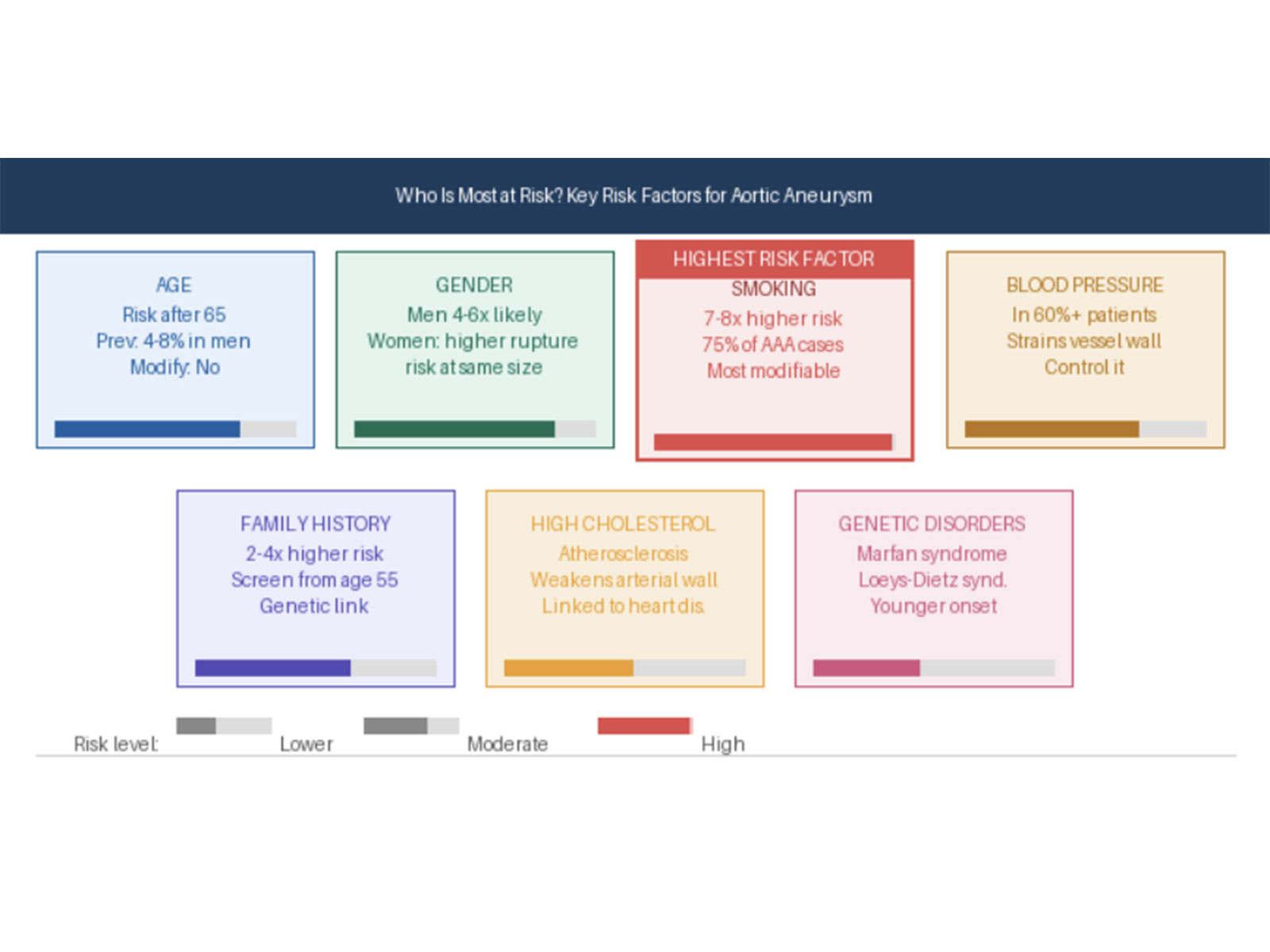
Men over 65 face a prevalence of four to eight per cent and are four to six times more likely than women to develop AAA [4] - yet women, when affected, face a three to four times higher rupture risk at the same aneurysm size, largely because they are under-screened. [5] Smoking accounts for approximately 75 per cent of all AAA cases; smokers are seven to eight times more likely to develop an aneurysm. [6] Hypertension is present in more than 60 per cent of AAA patients and independently drives both growth and rupture risk. [7] A family history of aortic aneurysm raises individual risk two to four times. [8]
The Case for Screening - and Modern Treatment
The most powerful number in this field is the gap in outcomes between planned and emergency treatment. Elective repair of an unruptured aneurysm carries a surgical mortality risk of less than one to two per cent in experienced centres. [9] Emergency repair of a ruptured aneurysm carries a mortality risk of 40 to 50 per cent - for those who reach the operating table at all. [3] A simple abdominal ultrasound - non-invasive, painless, and widely available across India - is sufficient to detect most aneurysms before they reach a dangerous size. [10] 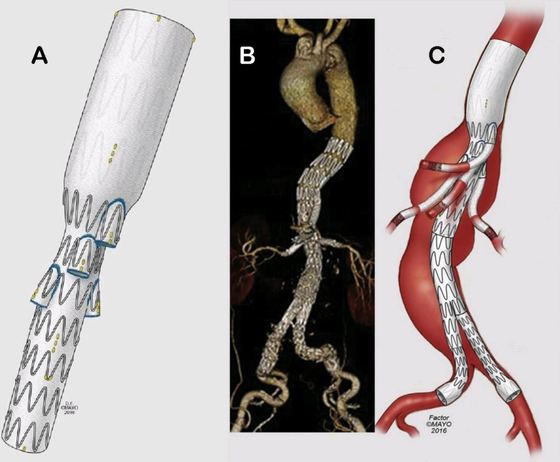
Stent-graft device design (A), post-EVAR CT reconstruction showing bifurcated stent-graft in situ (B), and anatomical illustration of deployed stent-graft excluding the aneurysm sac (C).
Image credit: Mayo Foundation for Medical Education and Research ©Mayo Clinic, 2016
For patients detected in time, Endovascular Aneurysm Repair (EVAR) has fundamentally changed what treatment looks like. A precision stent-graft is guided through a small groin puncture - no open incision, no prolonged anaesthesia. Once deployed, it creates a reinforced channel for blood flow and eliminates rupture risk. Clinical trials confirm EVAR reduces 30-day operative mortality by more than 60 per cent compared to open surgery. [9], [11] Most patients go home within two to three days.
"A planned procedure versus a race against death in an emergency theatre. That gap - between one per cent and fifty per cent - is the most powerful argument for screening." - Dr. Bhavin L. Ram
Five Things the People Must Know
* Screen early. If you are a man over 65, a smoker, or have a close relative with an aortic aneurysm, ask your doctor about a screening abdominal ultrasound.
* Control blood pressure. Uncontrolled hypertension is one of the most significant drivers of aneurysm growth and rupture.
* Stop smoking. Tobacco causes cumulative structural damage to arterial walls; quitting at any age reduces risk.
* Do not ignore persistent pain. A deep, persistent abdominal or back pain should not be dismissed - in some cases it signals an expanding aneurysm.
* Act immediately. A sudden tearing pain in the chest, abdomen, or back is a medical emergency. Call for help without delay.
About the Expert
Dr. Bhavin L. Ram (MS, DNB - Vascular Surgery) is a Consultant Vascular and Endovascular Surgeon at Yashoda Hospitals, Hitec City, Hyderabad, with over 14 years of clinical experience. He has presented research at the Society for Vascular Surgery Annual Meeting (Chicago) and the Charing Cross Symposium (London), and has published in the European Journal of Vascular and Endovascular Surgery and the Journal of Vascular Surgery.
Appointments: Yashoda Hospitals, Hitec City.
For more details Contact:
Mobile : 9391925929
Email : [email protected]
(ADVERTORIAL DISCLAIMER: The above press release has been provided by VMPL. ANI will not be responsible in any way for the content of the same.)