You Want to Study Design in India. Here's Where to Actually Look
Mar 27, 2026
VMPL
New Delhi [India], March 27: Every year, hundreds of thousands of students prepare for design entrance exams hoping to land a seat at NID, NIFT, or one of the IITs. Most of them don't. That's not a knock on them -- those institutions admit a few hundred students between them, and the competition is genuinely brutal.
What's changed over the last decade, though, is that the fallback options are no longer just fallbacks. Several private design institutes across India have built real programmes, hired faculty with actual industry experience, and started producing graduates who get hired. Not all of them, of course. But enough that the old hierarchy of 'government-or-nothing' deserves a second look.
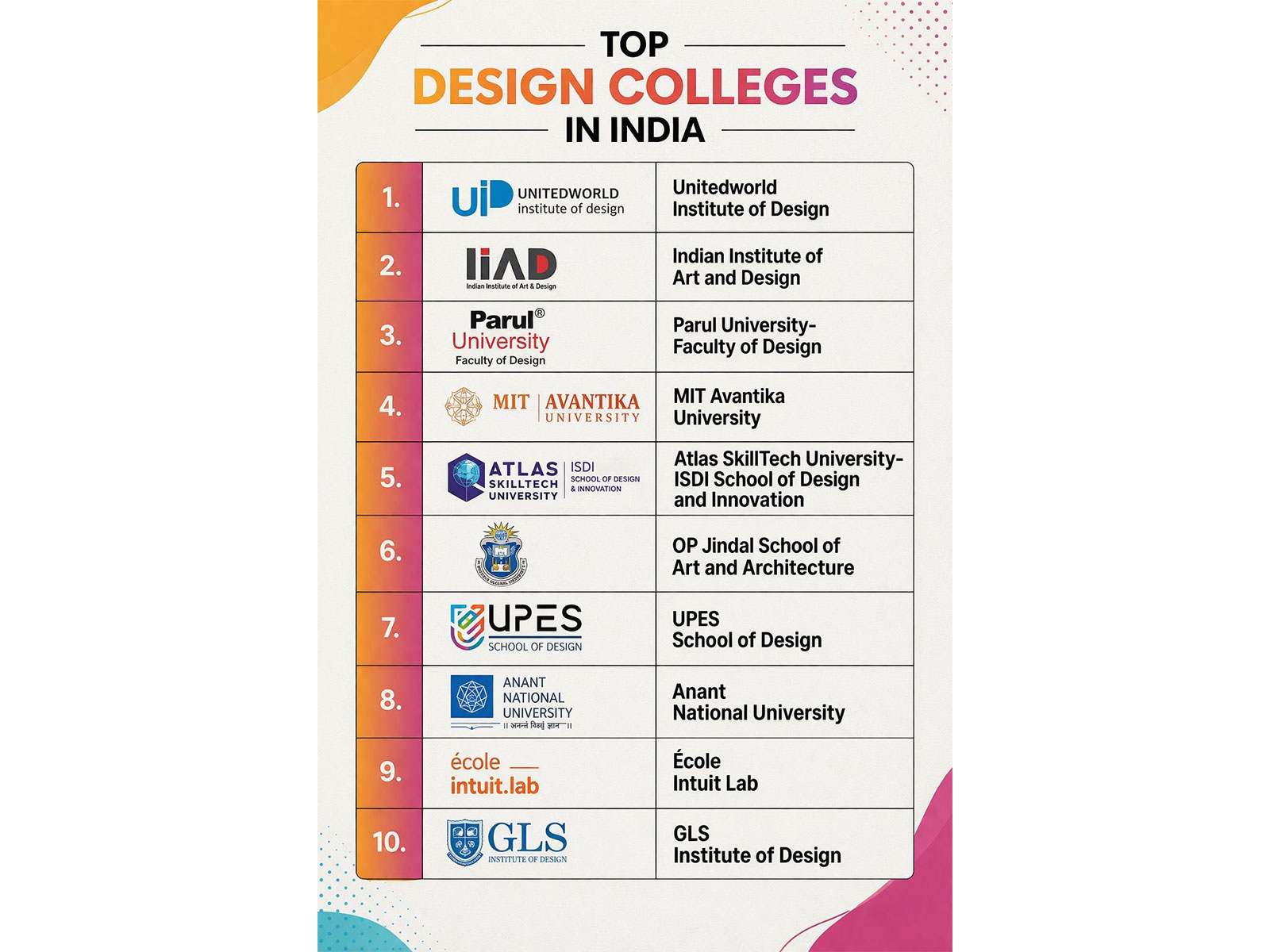
If you're planning to apply for a B.Des programme in 2026 -- or helping someone who is -- here are ten private institutes worth considering, with an honest take on what each of them actually offers.
Application Form Links
1. Unitedworld Institute of Design (UID), Karnavati University
Ahmedabad * Delhi NCR * Bengaluru
UID has been around long enough to have a track record, which matters more than most prospectus language will tell you. The institute covers product design, visual communication, animation, fashion, and interior design across its campuses.
What sets it apart from newer entrants is the seriousness of its studio culture. The learning is hands-on by design -- workshops with practitioners, international tie-ups, and a genuine push to get students working on real briefs before they graduate. Three campuses also means slightly better odds of getting a seat in a city that suits you.
Quick take:
* Functional international collaborations, not just name-drops
* Studio-based learning with live industry projects
* Reasonable campus infrastructure across three cities
2. Indian Institute of Art and Design (IIAD), New Delhi
New Delhi
IIAD is a fairly well-regarded name in fashion and communication design circles, and its location in Delhi gives it access to a reasonably active industry ecosystem. The pedagogy is studio-driven -- students build portfolios as they go, which is exactly how design education should work.
One thing that comes up consistently with IIAD is its emphasis on sustainability as a design lens, not just a buzzword in course descriptions. Whether that translates meaningfully into the curriculum depends on the individual course, but it's a stated priority worth asking them about during the admissions process.
Quick take:
* Strong portfolio development focus
* Delhi location gives good access to design agencies and studios
* Known for fashion and communication design specifically
3. Parul University -- Faculty of Design
Vadodara
Vadodara has a long history with art and design -- the MSU Fine Arts faculty has been producing painters and sculptors for decades -- and Parul has positioned itself to benefit from that cultural context.
The Faculty of Design covers fashion, communication, product, and interior design. The approach leans heavily on live projects and internships, which is the right instinct. A caveat worth noting: Parul is a large university with many disciplines, and design students sometimes find themselves navigating a campus where design isn't the clear institutional priority. Worth asking specifically about faculty bandwidth and studio access.
Quick take:
* Affordable relative to peers in the list
* Active internship and live project integration
* Good city for design history and culture
4. MIT Avantika University
Ujjain / Indore Region
Avantika markets itself as India's first design-centric university, and while that claim is debatable, the intent is clear. Design thinking isn't siloed here -- it runs across industrial design, UX, and communication, which makes for a more integrated learning experience than institutes where disciplines sit in separate silos.
The focus on problem-solving and entrepreneurship is real. Students are pushed toward real-world challenges, not just formal exercises. For students who know they want to work in product or UX, this is one of the more interesting options in central India.
Quick take:
* Genuinely interdisciplinary, not just in name
* Strong entrepreneurship angle for product and UX-oriented students
* Growing industry connections in the Indore region
5. Atlas SkillTech University -- ISDI School of Design & Innovation
Mumbai
ISDI's association with Parsons School of Design in New York gets mentioned a lot in its marketing. The question is always how deep that partnership runs in practice. Based on what's visible from the outside, the curriculum does carry some global structure, and the Mumbai location puts students close to the advertising, media, and startup ecosystem that dominates India's creative economy.
If you want to work in design in Mumbai after graduating, studying there has obvious advantages. The networks, the internship pipelines, and the sheer density of agencies and studios in the city are things you can't replicate on paper.
Quick take:
* Mumbai location is genuinely useful for creative industry exposure
* Parsons curriculum influence gives global design sensibility
* Good for students targeting media, branding, or startup design roles
6. OP Jindal Global University -- Jindal School of Art & Architecture
Sonipat (Delhi NCR)
Jindal Global is better known for law and international relations, but its School of Art & Architecture has grown into a legitimate option for design students who want to study within a liberal arts environment. That framing matters -- if you're the kind of student who wants to read sociology alongside studio work, or explore design's relationship to public policy, Jindal gives you room to do that.
The trade-off is that design isn't the core identity of the university the way it is at a place like UID or ISDI. Students who need a tightly structured design education might find the flexibility disorienting.
Quick take:
* Strong academic environment for contextually minded designers
* Good for students interested in design + humanities or policy
* Well-funded campus with broad international academic ties
7. UPES School of Design
Dehradun
UPES tends to get overlooked because Dehradun isn't a major design city, but the School of Design has built programmes in transportation design and interaction design that are harder to find elsewhere at the undergraduate level.
Transportation design in particular is a niche that UPES takes seriously -- and it's a field with real industry demand from automotive and mobility companies. If that's your area of interest, it's worth investigating beyond just the rankings.
Quick take:
* One of the few institutes offering transportation design at B.Des level
* Technology-integrated curriculum
* Solid placement support, especially for technical design roles
8. Anant National University
Ahmedabad
Anant is unusual in this list because sustainability isn't just a course module -- it's the organizing principle of the entire institution. Architecture, product design, and urban planning are taught through the lens of environmental and social responsibility.
That's a genuine differentiator. If you believe design's most important work over the next few decades will be in climate response, material innovation, and equitable urbanism, Anant is building towards that. It's a young institution, which means rougher edges but also more faculty access and a culture that's still forming its identity.
Quick take:
* Sustainability and built environment as core focus, not an elective
* Small cohorts mean more direct faculty engagement
* Ahmedabad has a strong architecture and design ecosystem
9. École Intuit Lab
Mumbai * Delhi
École Intuit Lab brings a French design school model to India, which means a European approach to graphic design, branding, and digital communication. The pedagogy combines rigorous academic foundation with consistent industry contact -- the way design schools in France typically operate.
It's a specialist institute, not a broad B.Des programme. If visual communication, branding, or creative strategy is where you're headed, the training here is more focused than you'd get at a generalist design school. Worth noting that admission numbers are small, which keeps the environment more atelier-like than university-like.
Quick take:
* European design pedagogy with strong industry integration
* Specialist focus on branding, digital communication, and creative strategy
* Small batches for a more intensive learning environment
10. GLS Institute of Design
Ahmedabad
GLS rounds out this list as a solid, accessible option in Ahmedabad -- a city that punches above its weight in design and architecture. The programmes span visual communication, animation, fashion, and product design, delivered through studio-based learning with regular industry interaction.
GLS isn't the most talked-about name, but Ahmedabad's design culture -- driven by NID's long presence there -- tends to benefit surrounding institutions. Students in the city naturally get exposure to exhibitions, workshops, and practitioners in ways that students in design-thinner cities don't.
Quick take:
* Affordable, well-structured option in a design-rich city
* Studio learning with active industry interaction
* Benefits from Ahmedabad's broader design ecosystem
Others Worth Keeping an Eye On
Five institutes that didn't make the main list but are worth researching depending on your specific interest:
* Whistling Woods International, Mumbai -- strong for media design and film-adjacent disciplines
* ITM Institute of Design & Media, Navi Mumbai -- smaller, more accessible entry point
* JK Lakshmipat University, Jaipur -- growing design faculty with a Rajasthan-specific cultural angle
* Pearl Academy -- multiple cities, strong fashion and lifestyle design reputation
* The Design Village, Noida -- newer, experimental, worth watchin
Application Form Links
Where Design Is Actually Going
One thing worth saying before you pick a college: design in 2026 is not what it was in 2010. The biggest demand isn't in fashion or print -- it's in UX, product innovation, mobility, and the overlap of design with climate and health.
That doesn't mean fashion or visual communication are bad career paths. It means that when you're evaluating a programme, the relevant question isn't just 'what does the brochure say' but 'where do the graduates from the last five batches actually work?' Ask that question. Most institutes will struggle to give you a straight answer, which is itself informative.
How to Actually Choose
Ignore rankings that don't explain their methodology. Most design college rankings in India are either paid placements or loosely defined surveys. They tell you almost nothing about teaching quality.
Instead, focus on a few things that actually predict outcomes:
* Where do recent graduates work? Not famous alumni from ten years ago -- people who graduated in 2022, 2023, 2024.
* What does the studio space look like? A good design institute has functional workshops, not just classrooms with whiteboards.
* Who is actually teaching -- full-time faculty or visiting lecturers who show up twice a semester?
* Does the city matter for your specialization? Mumbai for media and advertising. Ahmedabad or Pune for product and industrial design. Delhi for communication and fashion.
* What's the actual fee -- and what does the scholarship situation look like?
The institutes on this list are worth your time. Some of them are genuinely good. None of them are automatically the right choice -- that depends on what you want to do after graduation, and there's no getting around doing that thinking first.
(ADVERTORIAL DISCLAIMER: The above press release has been provided by VMPL. ANI will not be responsible in any way for the content of the same.)