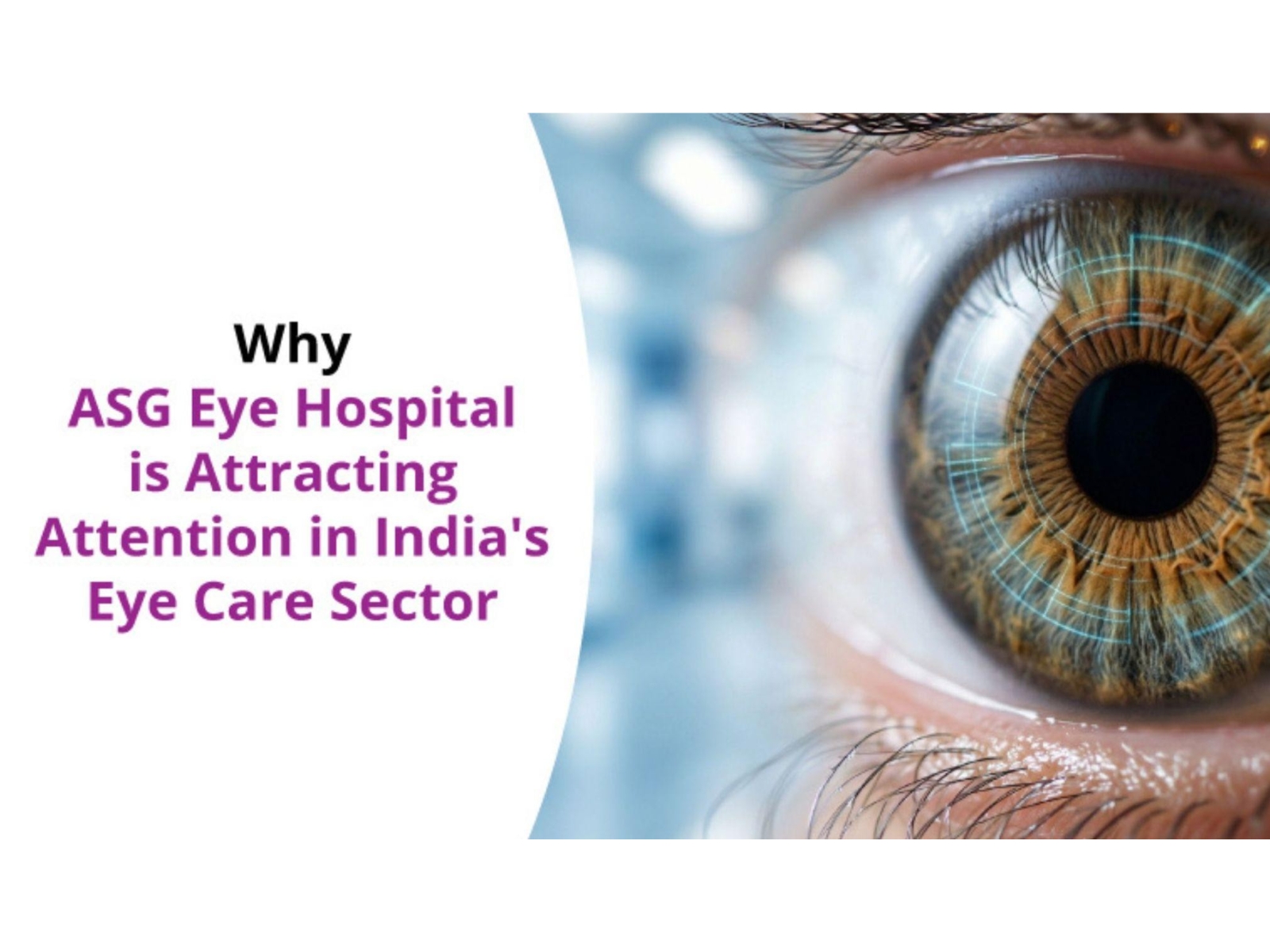
Why ASG Eye Hospital Is Attracting Attention in India's Eye Care Sector
Mar 31, 2026
PNN
New Delhi [India], March 31: India is witnessing a silent surge in vision-related disorders, creating a massive demand for organised and technology-driven eye care services. What was once considered a concern mostly for older adults has quietly become a much wider public health issue, one that touches school children glued to their screens, working adults managing uncontrolled diabetes, and an ageing population dealing with conditions they never saw coming.
The response to this growing challenge is shaping one of the more significant shifts in Indian healthcare right now, and ASG Eye Hospital is at the centre of that conversation.
The Rise of ASG Eye Hospital in India's Eye Care Market
Founded in 2005 by doctors trained at AIIMS New Delhi, ASG Eye Hospital started with a straightforward goal: bring high-quality eye care to patients in Tier 2 cities who had very few options at the time. What began as a single centre in Jodhpur has since grown into a network of over 180 hospitals across 95-plus cities in more than 20 states, with over 700 eye specialists and a record of treating more than three crore patients.
That kind of growth does not happen by accident. It reflects a genuine gap in the market and a consistent effort to fill it, not just in cities where quality care already exists, but in the places where it has historically been hard to find.
Growing Demand for Quality Eye Care in India
Three things are driving the rise in eye problems across the country, and none of them show signs of slowing down.
Screen time is the most visible one. Smartphones and laptops have fundamentally changed how Indians spend their hours. Children are being diagnosed with short-sightedness at younger ages than any previous generation, and digital eye strain has gone from being a fringe complaint to something eye specialists see in their clinics every single day.
Diabetes adds a deeper and more serious layer to the problem. India carries one of the largest diabetic populations in the world. A common complication of poorly managed diabetes is diabetic retinopathy, which damages the blood vessels at the back of the eye and can cause permanent vision loss if it goes undetected. The difficult part is that it rarely causes noticeable symptoms early on, so many patients do not realise there is a problem until it has already progressed.
An ageing population adds the third dimension. As more Indians live longer, age-related conditions such as cataracts and glaucoma have naturally become more common. These are not rare diagnoses. They are the predictable result of a population that is getting older, and the scale at which they need to be addressed is increasing year on year.
Together, these three pressures have created a real and growing need for structured eye care that goes well beyond what fragmented, standalone clinics can reliably provide.
The Eye Care Market Opportunity in India
The eye care market in India is on a clear growth path through the rest of this decade. Rising patient volumes, greater awareness about eye health, and increasing demand for procedures like LASIK surgery in India and treatment at cataract surgery hospitals are all contributing to that trajectory.
The more interesting part of this story is where the demand is actually coming from. For a long time, quality eye care was something you could only reliably access in a metro city. A patient in a smaller town needing a retina specialist or a surgeon comfortable with complex cataract surgery often had no real option but to travel. That dynamic is changing.
How ASG Eye Hospital Is Expanding in Tier 2 and Tier 3 Cities
Tier 2 and Tier 3 cities are now seeing real and sustained demand for specialised eye treatment. Patients in these cities are no longer willing to accept the inconvenience of travelling to a metro for care that a well-equipped local hospital should be able to provide.
ASG Eye Hospital recognised this shift early and built its expansion strategy around it. Rather than concentrating its centres in already well-served urban locations, the network deliberately grew into cities and towns where patients had limited access to specialists. This approach is part of why ASG's hospital network spans such a wide geography today.
On the supply side more broadly, the divide between organised and unorganised eye care providers in India remains significant. A large share of eye care is still delivered by standalone clinics that operate without consistent protocols, reliable diagnostic equipment, or structured follow-up systems. For a routine eye check, that may be sufficient. For chronic or progressive conditions, it often is not.
Why ASG Eye Hospital Is Among the Best Eye Hospital Networks in India
Organised eye care chains in India are built to solve problems that standalone clinics simply cannot manage at scale. When a hospital network operates across many cities, it can standardise the way patients are diagnosed, treated and followed up, so the experience and the quality of care do not vary based on location.
ASG Eye Hospital has built its reputation as one of the best eye hospital networks in India on exactly this kind of consistency. Whether a patient walks into a centre in or any of the network's other locations, the clinical standards, the equipment and the post-treatment care remain the same. That reliability is something patients and their families notice and remember.
Jodhpur, AmritsarThere is also a trust dimension to this that matters more than it might seem at first. People tend to feel more comfortable with a hospital they recognise, especially when the condition is serious or the procedure is one they have not encountered before. That trust is not built through marketing. It is built through years of consistent outcomes and honest communication with patients, which is precisely what an eye hospital in India operating at this scale has the systems and the incentive to maintain.
Advanced Eye Treatments at ASG Eye Hospital
Technology has become a meaningful part of how eye care is delivered, and the treatments available today are noticeably more effective and comfortable than those that existed even a decade ago.
LASIK surgery in India has advanced considerably. Procedures like Contoura LASIK use topography-guided laser mapping to customise treatment according to each patient's unique corneal surface. The results are sharper, recovery is quicker, and the overall experience is far more straightforward than it used to be. Demand for these procedures is rising steadily among young professionals and students who want a lasting solution rather than a lifetime of glasses or lenses.
AI-based diagnostic tools are changing how conditions like glaucoma anddiabetic retinopathy are found and monitored. These tools can pick up early changes in imaging data that might otherwise be missed in a busy clinic. In conditions where early detection can prevent irreversible damage, that capability is genuinely important.
On the surgical side, robotic and laser-assisted techniques have raised the precision of procedures like cataract surgery and reduced the time patients need to recover before getting back to their normal routine. These technologies are not limited to a handful of premium urban hospitals. ASG deploys them across its network, which means patients in smaller cities get the same standard of care as those in major metros.
Patient Outcomes at ASG Eye Hospital
The shift toward organised, technology-led eye care has a direct and meaningful impact on the people who actually go through it.
Recovery times have shortened considerably. A patient having cataract surgery today is often back to daily life within a day or two. For working adults and older patients, that matters a great deal. It means less time away from family and work, and less disruption to everyday life.
Outcomes have improved alongside the technology. Earlier detection means conditions are treated before they reach a critical point. Better surgical precision means fewer complications and more predictable results. The follow-up systems that organised hospitals maintain mean patients are not left to manage things on their own after treatment.
Perhaps the most underappreciated change is in awareness. Community eye screening camps and outreach programmes run by networks like ASG have introduced many people to proper eye care for the first time. Conditions caught at these camps, whether early retinal changes, squint in children or the beginning stages of glaucoma, respond far better to treatment than the same conditions detected years later.
More and more people are treating eye health as something to take care of before a problem becomes serious, not just after.
Looking for the Best Eye Hospital in India? Why Choose ASG Eye Hospital
If you are looking for a trusted eye hospital in India with a track record of consistent care across a wide range of conditions, ASG Eye Hospital is worth considering seriously. With two decades of experience, a presence across more than 20 states, and specialists trained in everything from routine consultations to complex surgical procedures, the network is built to serve patients at every level of need.
Whether you need LASIK surgery, cataract treatment, management of a retina condition or care for a child with a squint, ASG brings the same standard of care to wherever you are. That consistency, across so many cities and such a diverse patient base, is what makes it one of the best eye hospital networks operating in India today.
The Road Ahead
India's eye care sector is heading toward a future built on preventive care, digital diagnostics and wider access than exists right now.
Tele-ophthalmology is beginning to bring initial screening to areas where setting up a physical clinic is not yet practical. AI tools are expected to make early detection a more routine part of care, even in settings without a full-time specialist on site. India is also drawing interest from international patients who come here for high-quality procedures at a fraction of what the same treatment would cost elsewhere, a sign that the standards being built within organised networks are being recognised globally.
The demand for quality eye care across India is going to keep growing. The question, as always, is whether the healthcare system can meet it in a way that is accessible, consistent and built to last. Organised eye care chains, with the infrastructure and the commitment to scale thoughtfully, are better placed than most to answer that question.
As awareness grows and technology evolves, organised eye care chains are set to play a defining role in shaping India's healthcare future.
FAQs
1. Why are eye care chains growing in India?
More people are dealing with eye problems, awareness is improving, and there is a clear need for consistent, specialist care across more cities. Organised chains can meet that demand in a way that standalone clinics often cannot.
2. Is ASG Eye Hospital available in smaller cities?
Yes. ASG has specifically expanded into Tier 2 and Tier 3 cities where patients previously had very limited access to specialist eye care.
3. Is LASIK surgery widely available in India?
LASIK surgery in India is available across most major cities and increasingly in smaller towns through organised hospital networks like ASG.
4. How common is cataract surgery in India?
It is one of the most frequently performed procedures at cataract surgery hospitals across the country, particularly among older adults. Modern techniques have made it faster and safer than ever before.
5. Why choose an eye hospital network over a local clinic?
For complex or long-term conditions, a hospital network offers standardised care, advanced equipment and reliable follow-up systems that independent clinics often cannot match.
(ADVERTORIAL DISCLAIMER: The above press release has been provided by PNN. ANI will not be responsible in any way for the content of the same.)