Kyptec Automation® Expands Machine Vision Cable Portfolio with Industrial GigE Ethernet Connectivity for High Speed Camera Systems
Sep 16, 2026
VMPL
New Delhi [India], September 16: Kyptec Automation® is expanding its industrial camera connectivity portfolio with a stronger focus on GigE Ethernet solutions for machine vision systems, OEM equipment platforms, system integrators, and industrial automation engineering teams. The expansion strengthens the company’s position across one of the most important parts of the machine vision signal chain: reliable transmission of image data between industrial cameras and processing systems. With an established portfolio spanning GigE Ethernet, Camera Link, M12 connectivity, and USB 3.0 architectures, Kyptec Automation® is developing deeper specialization around industrial camera communication while supporting engineers who require repeatable, documented, and technically appropriate connectivity for modern vision systems.
Industrial imaging performance depends not only on the camera and lens but also on the communication path carrying acquired image data to the processing environment. Increasing camera resolution, frame rate, bit depth, and continuous acquisition requirements can place greater demands on bandwidth, signal integrity, connector security, shielding, cable routing, and installation quality. A camera can produce high quality image data, but unstable connectivity may still result in communication interruptions, dropped frames, intermittent detection, or unnecessary troubleshooting. Kyptec Automation® is therefore positioning its machine vision cables as engineered elements of the complete acquisition architecture rather than treating industrial camera cables as generic accessories.
GigE Ethernet connectivity forms an important part of this strategy because Ethernet based industrial camera architectures allow image data to be transmitted through widely understood network technology while giving machine builders flexibility in camera placement and system layout. Kyptec Automation® provides CAT 6 GigE connectivity using shielded RJ45 connectors and copper conductors designed for reliable data transmission in machine vision environments. Its CAT 6 configuration uses 28 AWG copper wire with shielded twisted pairs, supporting an engineering approach in which conductor construction, shielding, connector design, cable length, and installation route are evaluated together when specifying industrial camera communication.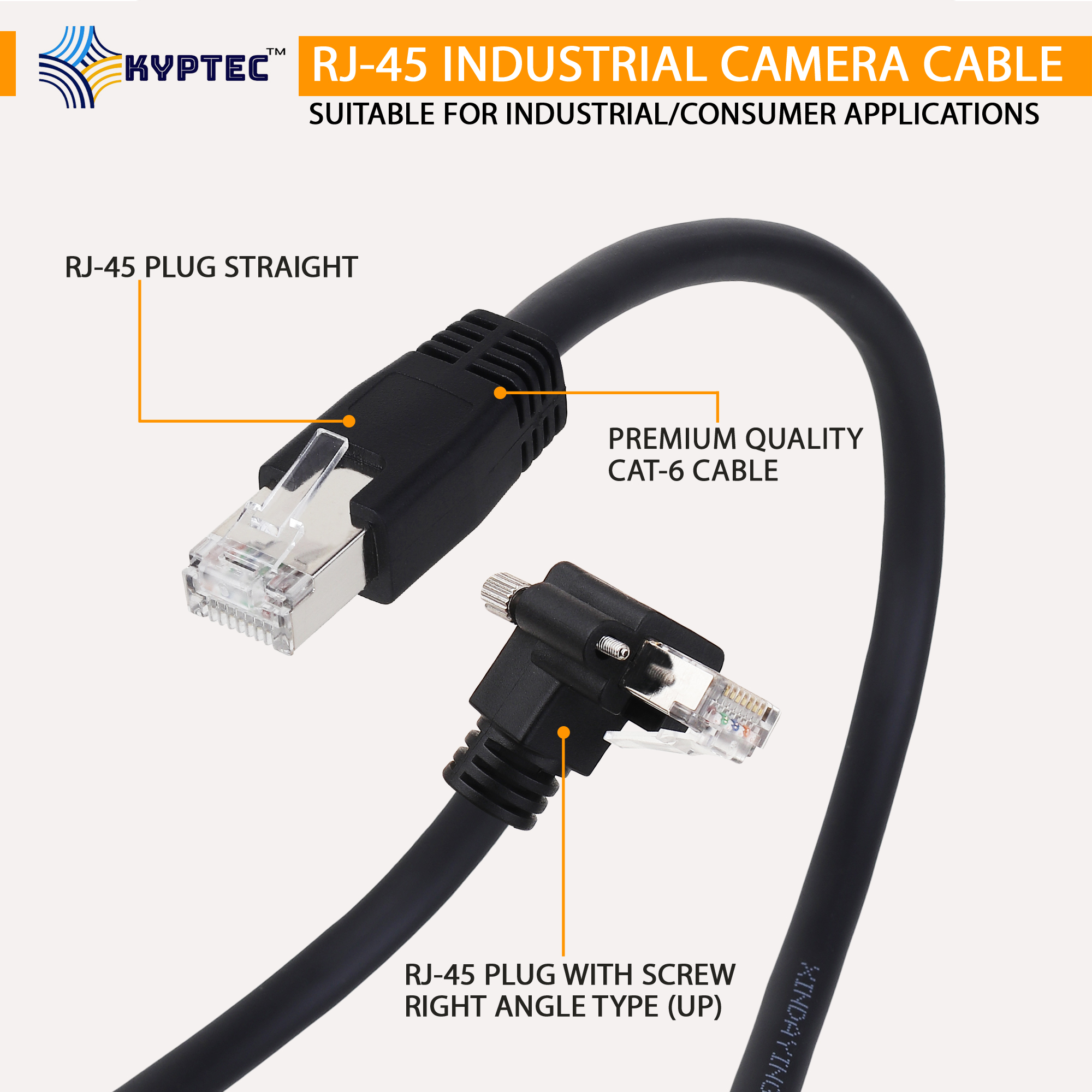
The company also provides CAT 8 Ethernet connectivity for systems requiring a higher performance physical network cable class. Kyptec Automation® specifies its CAT 8 cable for Ethernet performance up to 40 Gbps and bandwidth up to 2000 MHz, using 26 AWG construction, shielded twisted pair architecture, and RJ45 connectivity. These cable ratings describe the physical Ethernet cable capability, while actual machine vision data throughput remains dependent on the camera, network interface, host hardware, protocol, and complete system architecture. This distinction is important because selecting an industrial GigE Ethernet cable should begin with the requirements of the complete camera system rather than choosing a cable category solely from its maximum theoretical rating.
Cable selection becomes increasingly important as machine vision architectures become more data intensive. Required bandwidth can be influenced by image width, image height, frame rate, pixel format, bit depth, number of cameras, and the way data traffic is handled by the host system. Engineers must also consider installed cable length, connector accessibility, available bend space, route through the machine, proximity to electrical equipment, service requirements, and mechanical movement. Kyptec Automation® is developing its connectivity portfolio around these practical engineering decisions so OEM teams can define cable specifications that are repeatable across prototype development, production machines, future service, and replacement requirements.
Mechanical configuration is another important part of industrial camera connectivity. A cable that performs correctly on a development bench may not be the best choice once the camera is installed inside a compact machine enclosure. Camera port orientation, available clearance, connector exit direction, service loops, bending space, retention, and routing around frames or panels can determine whether a straight connector or another physical arrangement is preferable. By supporting different GigE cable configurations within its wider machine vision connectivity portfolio, Kyptec Automation® is addressing the relationship between electrical communication requirements and the physical geometry of industrial equipment.
“Reliable machine vision connectivity begins with understanding the complete data path from the camera to the processing system,” said Nitin Aggarwal, Co Founder and CEO of Kyptec Automation®. “Bandwidth is important, but industrial engineers must also consider shielding, connector architecture, cable length, routing, mechanical stability, and how the connection will perform throughout repeated machine operation. Our objective is to build a stronger GigE Ethernet portfolio that helps OEMs and system integrators treat camera connectivity as an engineering specification rather than an afterthought.”
For OEM machine builders, this approach also supports cable standardization. Once a GigE camera architecture has been validated, engineering teams can document the approved interface, connector arrangement, cable construction, length, route, and installation requirements for repeated machine production. Standardization can reduce unnecessary variation between machines, simplify bills of materials, improve replacement planning, and provide service teams with clearer connectivity documentation. For system integrators, defined cable architecture can also make troubleshooting more systematic because the physical communication path is specified as part of the vision system rather than selected independently during final installation.
Kyptec Automation® is building its wider camera connectivity strategy around clearly separated interface families because GigE Ethernet, Camera Link, M12, and USB 3.0 represent different engineering requirements. A cable should be selected according to the actual camera interface, endpoint connectors, required length, bandwidth requirement, mechanical environment, and retention needs. Connector appearance alone is not sufficient to determine compatibility. This interface focused structure allows the company to deepen technical authority around individual connectivity technologies while giving OEM customers a broader sourcing platform for industrial camera communication.
The expansion of Kyptec Automation® GigE Ethernet connectivity supports the company’s wider objective of strengthening its global position in machine vision and industrial automation technology. As industrial cameras continue to generate greater quantities of image data and automated systems become more dependent on continuous visual information, reliable communication between imaging devices and processing systems becomes increasingly important. By combining CAT 6 and CAT 8 Ethernet options, shielded industrial construction, RJ45 connectivity, multiple machine vision interface families, and an OEM focused engineering approach, Kyptec Automation® is strengthening its role as an industrial camera connectivity brand for machine builders and system integrators developing reliable, scalable, and repeatable machine vision systems worldwide.
CONTACT US:
Kyptec Automation®
C/o BalaJi MicroTechnologies Pvt. Ltd.
(A Unit of B.B. Group Of Companies)
NO. C-79, UPPER GROUND FLOOR,
DDA SHEDS OKHLA INDUSTRIAL AREA,
OKHLA PHASE-1, NEW DELHI-110020, INDIA
Email ID: [email protected]
Website: https://www.kyptec-automation.com/
Mobile/WhatsApp: +91-9217165630
(ADVERTORIAL DISCLAIMER: The above press release has been provided by VMPL. ANI will not be responsible in any way for the content of the same)