Bharatiya Nyaya Shastra - Ancient Indian Jurisprudence Treatise by Former Union Minister Dr. Veerappa Moily Launched at Jindal Global Law School
Apr 18, 2026
OP Jindal University
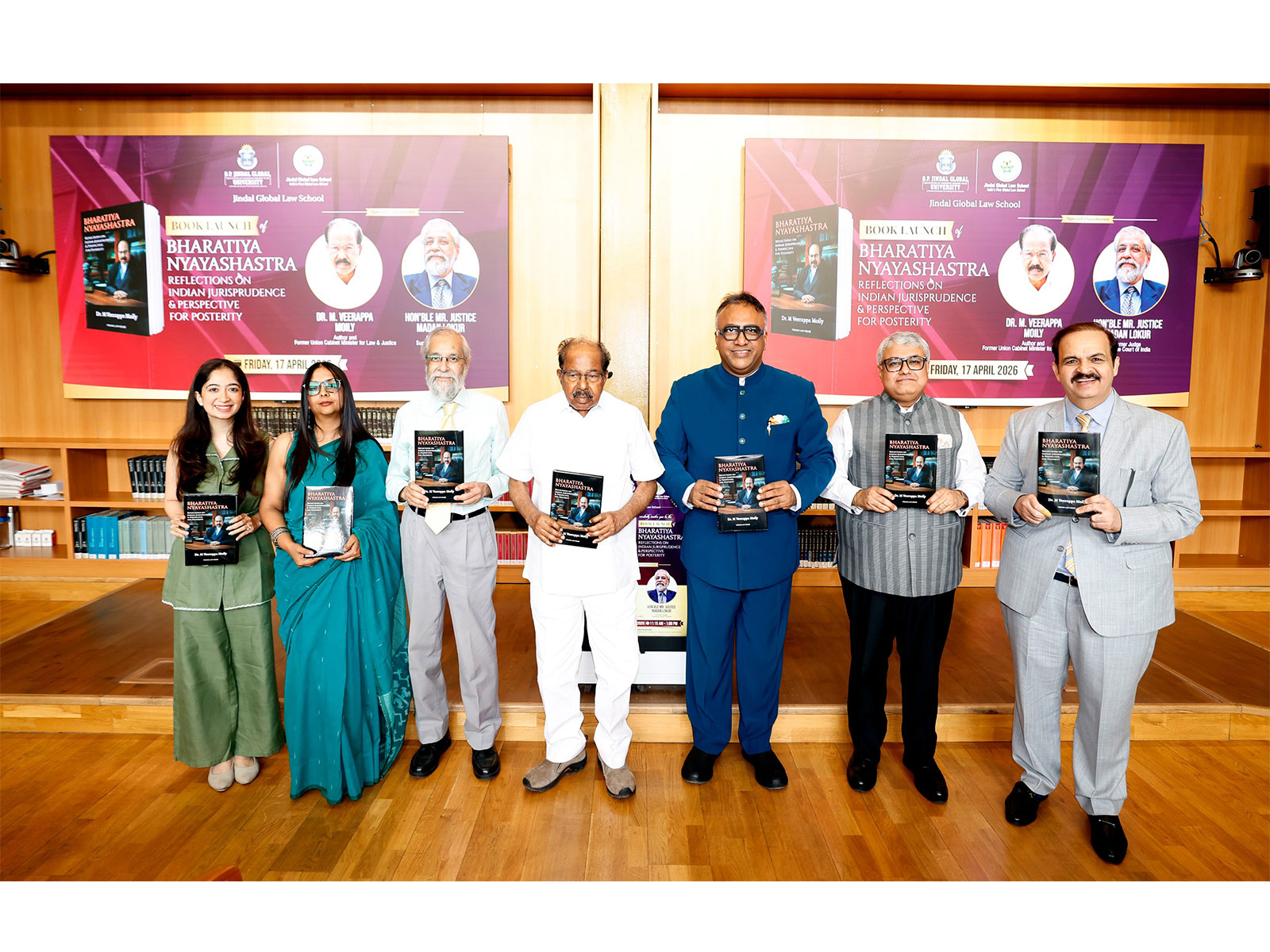
Sonipat (Haryana) [India], April 18: O.P. Jindal Global University (JGU) was honoured and delighted to launch the latest book Bharatiya Nyaya Shastra: Reflections on Indian Jurisprudence & Perspective for Posterity by Dr. M. Veerappa Moily today.
Author and former Union Cabinet Minister for Law & Justice, Government of India, and a renowned jurist, Dr. Veerappa Moily said, "Ancient India's judicial system was the most secular and liberated system in the world. The Rishis came out with a justice system which can be emulated not only by the judicial system of India but of the world over. Ancient Indian jurisprudence is an ideal system where it was struggling to liberate itself from the clutches of religion for centuries and also from fundamentalism and religious regimentation. Ancient India used to be studded with democracies. A study of the Buddhist Bhikshu Sanghas disclosed that they were like parliaments, observing all the rules of parliamentary procedures known to modern times, which included motions, resolutions, quorum, whip, counting votes, voting by ballot, censure motion, Res Judicata, and more."
Dr. Moily further elucidated that he was encouraged by Justice S.A. Bode, former Chief Justice of India, to write a book on ancient Indian jurisprudence. "Such a classical book warrants very deep research," he said. "According to the Brihaspati Smriti, there was a hierarchy of courts in ancient India, a chief justice called the Praadivivaka, starting from family courts up to the king's court. The idea of justice has travelled a long distance since the emergence of the idea of the rule of law on the horizon of legal history and jurists," Dr. Moily elucidated. "Therefore, the doctrine of the rule of law was fully practiced in ancient India, and justice was administered according to the law. As Manu states in Dharmarm Sasvatamasritya Kuryatkaryavinirnayam, all decisions should be according to the established Dharma, and nobody was above the law, from the ordinary people to the king himself!" The distinguished author and former Union Minister further dwelt on the issue of morality and ethics and explained how the book has been the outcome of sustained research, study, and consultation with eminent jurists and experts.
Welcoming Dr. Veerappa Moily to the JGU campus, the Founding Vice Chancellor of O.P. Jindal Global University, Prof. (Dr.) C. Raj Kumar said, "It's a very special day today to launch the book authored by Dr. Veerappa Moily. Besides the fact that he was India's law minister, corporate finance minister, cabinet minister for petroleum and natural gas, he led many extraordinary intellectual initiatives too. He helped establish the National Law School, Bangalore, and many more. He brought in the corporate affairs ministry's provision to have CSR becoming part of the company law provision, which ensures that companies and corporations contribute towards corporate social responsibility. He played an active role in the National Commission to Review the Working of the Constitution, focusing on ethics and public life, led legal and judicial reforms through multiple reports and levels of engagement, including issues surrounding alternative dispute resolution, mediation, and more. Dr. Moily, who has honoured us with his visit, is a remarkable, inspiring, transformative leader who believes in nation-building and believes in institution-building."
The special address was given by Hon'ble Mr. Justice Madan Lokur, former Judge of the Supreme Court of India, who said, "This book is remarkable for the research that has been done on the Neeti of the Shastras in ancient India. Ancient texts speak about the doctrine of expiation, wherein a person who has committed an offence and has undergone a sentence is like any other person in society. This was a concept which existed in ancient India more than 5000 years ago. Today, we need to look at our procedures, practices, and codes and understand what we do for justice. Can we dismantle some of those procedures and look at something better so that we are able to deliver justice to our people much faster than we have been doing now?"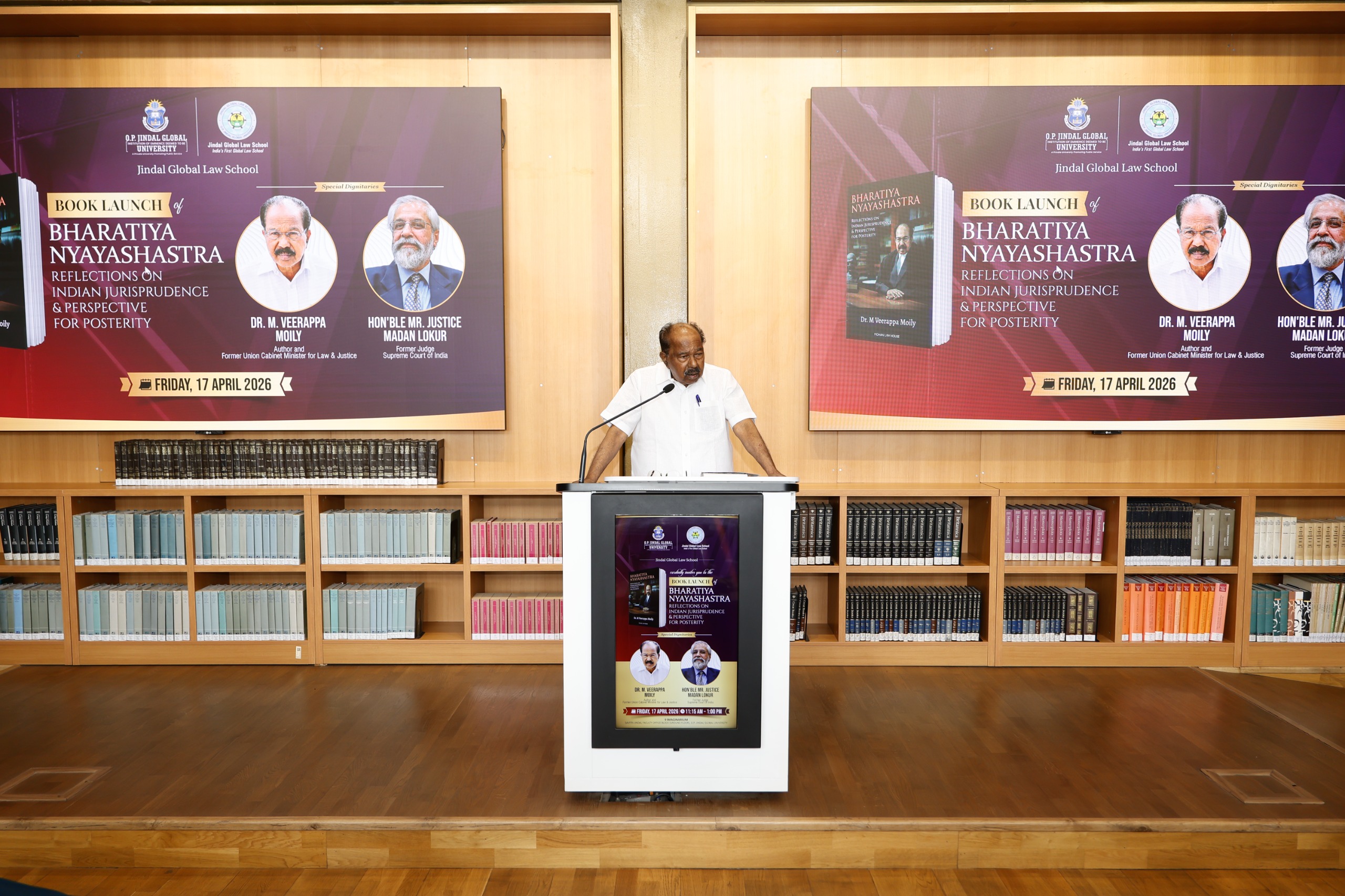
Prof. (Dr.) Dipika Jain, Executive Dean & Professor, Jindal Global Law School, gave the welcome address and said, "Today we are not just launching a book but celebrating a rich intellectual tradition, revisiting the philosophical foundations of Indian jurisprudence, and engaging with ideas that shape legal thought."
The launch was followed by an insightful panel discussion with faculty from the Jindal Global Law School and included Prof. (Dr.) Samiparna Samanta, Professor; Prof. (Dr.) Arup K. Chatterjee, Professor; Prof. (Dr.) Amit Bindal, Professor; and Prof. (Dr.) Shailza Sharma. The discussion was moderated by Prof. (Dr.) S. Sreejith, Dean, Strategy and Institution-Building & Director, Endowment Development & Philanthropic Initiatives, Office of the Vice Chancellor.
Dr. Vinay Ahuja, Publisher and Co-Founder, Mohan Law House India & UK, gave the introduction to the book, and the vote of thanks was given by Prof. Dabiru Sridhar Patnaik, Registrar, O.P. Jindal Global University.
(ADVERTORIAL DISCLAIMER: The above press release has been provided by OP Jindal University. ANI will not be responsible in any way for the content of the same)